
Dark Caracal targets Venezuela with GoCaracal, an upgraded Bandook toolkit and an Ethereum fallback for resilient C2 communications.
Dark Caracal is back with new malware and the same hunting grounds. Arctic Wolf Labs researchers link a June 2026 intrusion against a communications organisation in Venezuela to the Lebanon‑linked espionage group, and says it deployed a previously undocumented Go‑based framework called GoCaracal alongside an updated Bandook backdoor.
Dark Caracal is an APT group associated with the Lebanese General Directorate of General. In past campaigns, it targeted entities in Singapore, Cyprus, Chile, Italy, the USA, Turkey, Switzerland, Indonesia, and Germany.
“In June 2026, Arctic Wolf Labs investigated a targeted intrusion affecting a communications organization in Venezuela. We assess with medium confidence that this activity is linked to Dark Caracal, a cyberespionage group associated with Lebanon’s General Directorate of General Security (GDGS) that has historically targeted governments, businesses, journalists, and activists.” reads the report published by Arctic Wolf. “GoCaracal supports separate lightweight and extended build profiles derived from a shared architecture. Both were observed in the same intrusion.”
The delivery method will feel familiar to anyone who has followed the group’s recent campaigns. Phishing emails with financial or tax lures drop weaponised SVG attachments, which redirect victims through URL shorteners to attacker‑controlled sites that serve the real payload.
When a recipient opens one of these SVG files, the embedded content directs the browser to a shortened URL that resolves through a redirector to getpdfdigital[.]cloud, a known attacker site used to stage malicious payloads. The site then delivers a 7‑Zip archive containing a lightweight Go implant that Arctic Wolf identifies as part of the GoCaracal framework.
“While Arctic Wolf did not recover the original phishing email or SVG attachment associated with the intrusion, the artifact’s financial and tax-themed filename, the campaign’s established delivery pattern, and more than 100 related SVG files found communicating with the same malicious hosting site support our assessment that the file was delivered through phishing.” continues the report.
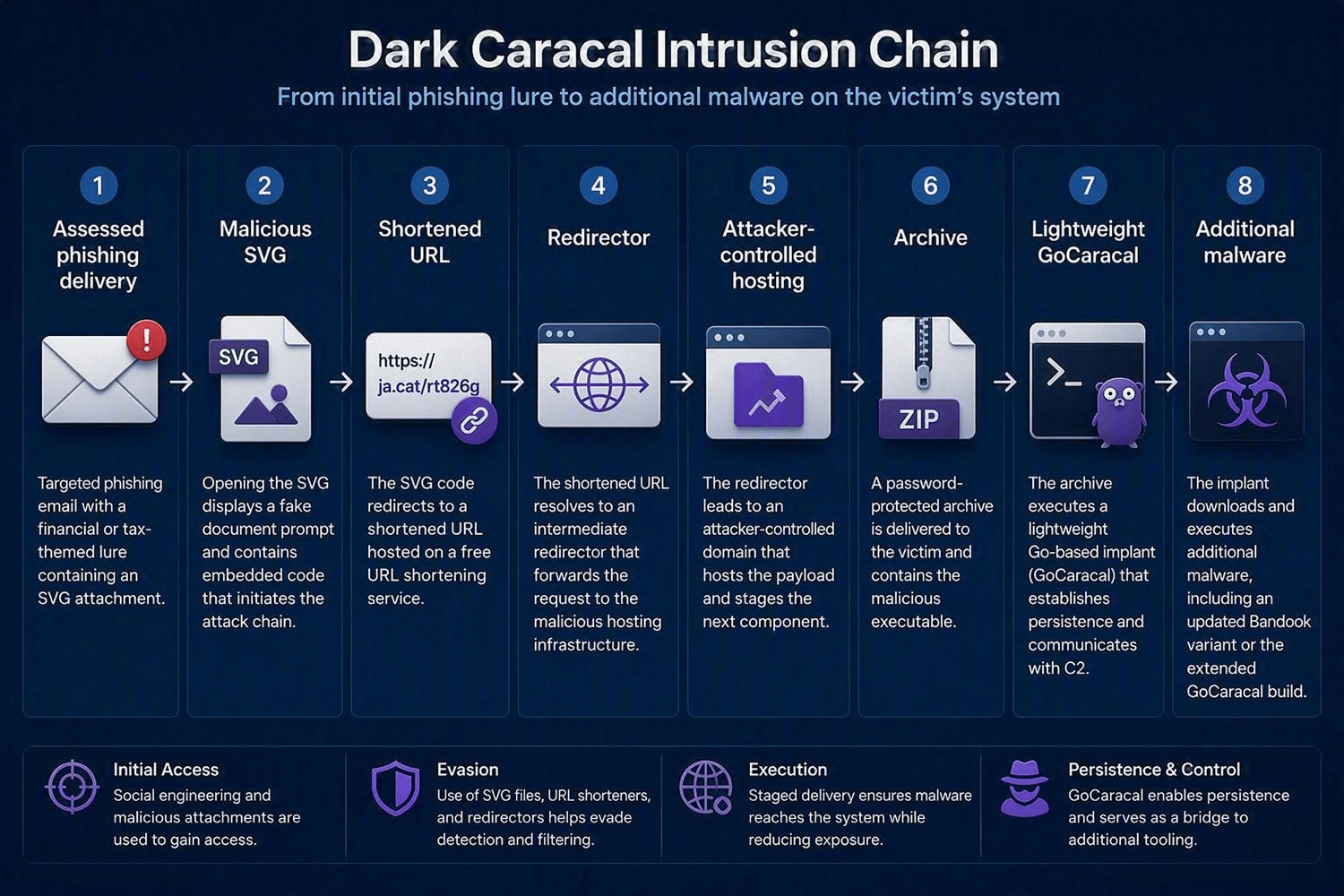
That initial implant is not the endgame. It establishes a foothold and then pulls in a Delphi loader carrying Bandook and a more capable, extended GoCaracal build with broader post‑compromise features.
The two profiles split the work. The lightweight build handles host profiling, encrypted C2, remote shell, payload download and execution, and shellcode injection. The extended build adds file management, browser credential and cookie theft, keylogging, targeted file search, WebRTC remote desktop, hidden browser sessions, a SOCKS5 proxy and persistence mechanisms.
Arctic Wolf traced 249 related samples from January to July 2026 and sees a clear development arc. GoCaracal started as a focused access implant, then became modular, then gained broad post‑compromise capabilities, and finally added an Ethereum‑based C2 fallback while keeping both profiles in play.
“Analysis of 249 related samples revealed two GoCaracal build profiles: a lightweight implant designed to establish access and deliver additional payloads, and an extended build intended for sustained intelligence collection and interactive control.” states the report. “The extended build also supports an Ethereum smart-contract fallback that allows operators to retrieve replacement command-and-control (C2) infrastructure without redeploying the malware.”
That fallback is the most interesting twist. The extended GoCaracal configuration can include an Ethereum smart‑contract address alongside the usual HOST and PORT values. If the malware cannot reach its primary C2 after repeated tries, it calls a public Ethereum JSON‑RPC endpoint, reads a stored value from the contract, and updates its in‑memory C2 address before retrying.
“An extended GoCaracal variant uses Ethereum smart contracts as a fallback source for replacement C2 addresses.” states Artic Wolf “Blockchain activity indicates that the capability was tested and operationalized rather than merely included as dormant code.”
Ethereum does not carry the malware’s entire command channel. Instead, GoCaracal uses it as a backup source for a new C2 address. This lets the attackers change the server the malware contacts without releasing a new version.
Arctic Wolf found a custom Solidity contract called BulletproofC2 that stores a changeable C2 address. Only its owner can update it. Transaction records show that the attackers changed the address to a public IP, suggesting they tested and used the system.
The same wallet also deployed similar contracts on Ethereum’s Sepolia testnet before moving some to the mainnet. The contracts contained both public and private IP addresses, suggesting the attackers first tested the mechanism before using it operationally.
GoCaracal is not replacing Bandook, at least not yet. Arctic Wolf says the two families now run in parallel, with GoCaracal augmenting the group’s existing toolkit and potentially reducing future reliance on Bandook, but current evidence does not show a full swap‑out.
The June 2026 Bandook sample shows deliberate anti‑analysis tweaks. Sequential command identifiers like @0001 through @0136 were replaced with randomised strings, and plugin export names were obfuscated with generic labels, preserving functionality while weakening signature‑based detection built on older naming conventions.
The wider campaign still looks like Dark Caracal. Arctic Wolf identified seven related Spanish‑language, document‑themed domains used to deliver malicious SVGs and downstream payloads, with two previously linked to the group and a new one registered in July 2026 observed delivering GoCaracal.
Infrastructure is compartmentalised. Of 24 unique C2 addresses extracted from GoCaracal samples, 23 sat on AEZA Group‑operated networks, while Bandook C2 addresses were hosted on AlexHost, a provider previously associated with Dark Caracal. That separation likely limits the blast radius if one provider gets hit.
Geographically, the focus remains Latin America. Arctic Wolf sees related artifacts and infrastructure tied to Brazil, Ecuador, Chile, Colombia, El Salvador and Uruguay, and assesses broader regional activity with moderate confidence while continuing to map the scope.
“Taken together, the findings show Dark Caracal is preserving familiar targeting and delivery practices while modernizing their malware and infrastructure.” concludes the report. “Dark Caracal’s continued use of established tooling such as Bandook, combined with the introduction of GoCaracal and its separate C2 footprint, suggests an expanding and increasingly compartmentalized toolkit rather than a wholesale change in operational strategy.”
Follow me on Twitter: @securityaffairs and Facebook and Mastodon
(SecurityAffairs – hacking, malware)
