
Digital Intelligence Lab (DIL) launches an observatory for reading cyber events as what they actually are: signals of a broader social and geopolitical reality.
The timing rarely lies, and the connection between real-world events and cyber activity is no longer a theoretical framework. It is a documented pattern, traceable across months and geographies. This new Observatory available for the community extends that work into a broader question: not just what cyber events are happening, but why now, where, and what else is happening around them.
The cases that built the argument
On February 2026, two days before the opening ceremony of the Milano-Cortina Winter Olympics, Italy’s Foreign Minister Antonio Tajani announced that the country had thwarted a series of Russian cyberattacks hitting foreign ministry offices and Olympics venues, including hotels in Cortina d’Ampezzo. NoName057(16) claimed the attacks directly. Three months later, on May 16, Austrian authorities reported approximately 500 cyberattack attempts against Eurovision Song Contest infrastructure in Vienna, targeting the official website, accreditation systems, and venue access controls. Austrian intelligence services were simultaneously monitoring groups linked to Iran, amid political tensions over Israel’s participation and street protests outside the venue.
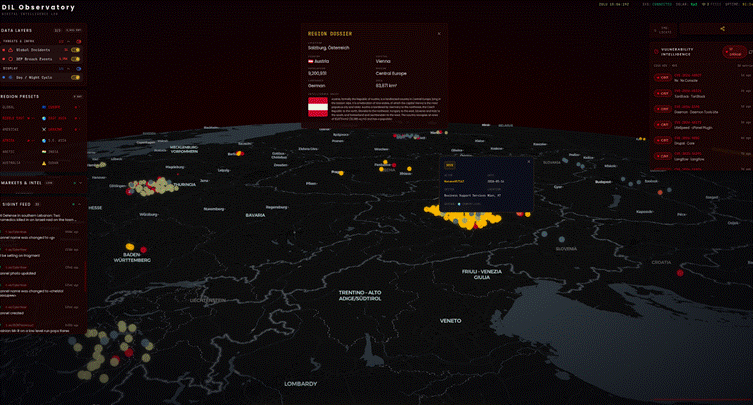
Figure. Cyber events cluster on Austrian territory on May 2026 (Source:DIL Observatory)
These are two separate events, two separate headlines, but sharing the same underlying logic: when the world concentrates attention on something, the digital domain responds.
The connection between real-world events and cyber activity is no longer a theoretical framework. It is a documented pattern, traceable across months and geographies.
In September 2024, NoName057(16) and OverFlame launched attack campaigns against Austrian government websites, airports, financial institutions, and the Vienna Stock Exchange, timed to the country’s national elections, with the group openly stating they were “testing Austria’s cybersecurity readiness” ahead of the vote. In May 2026, the same group hit Romanian government websites during the presidential election rerun, taking down the Ministry of Foreign Affairs, the Constitutional Court, and candidate websites on election day itself. In Denmark, investigators confirmed that pro-Russian infrastructure attacks were concentrated in the exact week of municipal elections.
On March, 2026, as Iran-Israel tensions were near a peak, a group identifying itself as “APT Iran” appeared on a dark web marketplace claiming to sell 375 terabytes of data allegedly taken from Lockheed Martin, asking $600 million for the archive. The same day, the Iran-linked Handala Hack Team published personal data of Lockheed Martin engineers by name, issuing a 48-hour ultimatum tied explicitly to geopolitical demands. Authenticity unverified, but the timing and the framing told their own story.

Figure. Digital retaliation on against Israeli infrastructures on May 2026 (Source:DIL Observatory)
In July 2025, similar pattern holded for Naval Group, France’s state-owned naval defense contractor, where the threat actor was claiming to hold a full terabyte archive including design schematics for military vessels and classified internal correspondence. Naval Group called it an act of “destabilization”. This month, a separate actor posted an alleged 3.5 terabyte of NATO databases on an underground forum, claiming it contained sensitive contact and organizational data across multiple allied defense institutions. Defense-sector leaks, real or amplified, don’t surface randomly. They surface when the political temperature around Western military cooperation is running high.
The digital domain does not operate totally in parallel to business and geopolitical reality.
What DIL is building, and why now
Digital Intelligence Lab has been tracking ransomware and extortion activity since 2020 through “doubleextortion.com”, one of the first Italian open-source projects dedicated to systematically mapping the ransomware ecosystem. The new DIL Observatory extends that work into a broader question: not just what cyber events are happening, but why now, where, and what else is happening around them.
The observatory tracks confirmed events, ransomware cases, breach disclosures, exploitation campaigns, cyber militias activity, threat actor communications, regulatory actions, and places them on a global map alongside the geopolitical and social context in which they occur, aiming to make the connections between events legible.
The Observatory, available at https://community.digintlab.com/ is built for the people who need that picture assembled, trying to anticipate what comes next, needing to translate a cyber incident into business or political consequence, researchers and journalists trying to understand how the digital world responds when the physical one shifts, and vice-versa.
Digital Intelligence Lab Srl is an Italian startup specialised in cyber intelligence for decision-making processes.
Follow me on Twitter: @securityaffairs and Facebook and Mastodon
(SecurityAffairs – hacking, DIL observatory)
