
Zimbra patched nine flaws in version 10.1.20, including a critical SNMP monitoring command injection issue enabling arbitrary command execution.
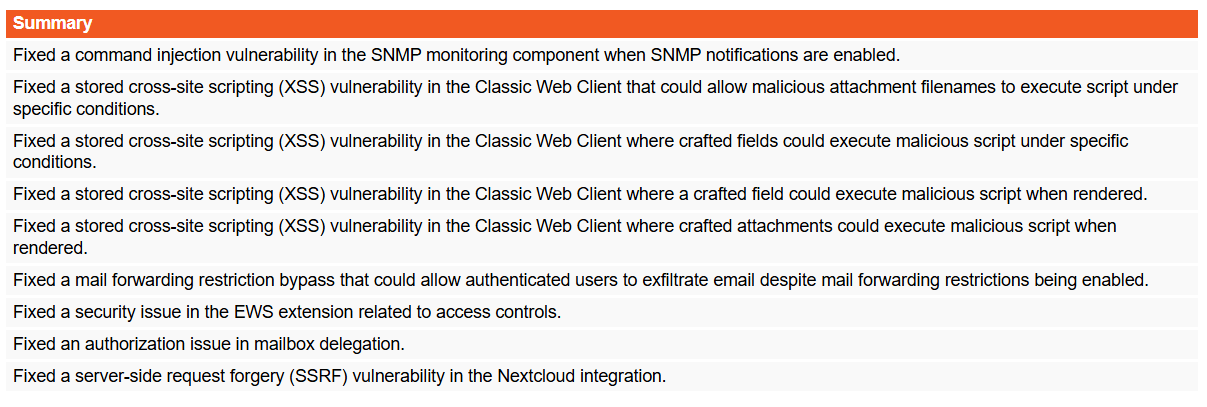
Zimbra released version 10.1.20 to fix nine security vulnerabilities, including a critical command injection flaw in the SNMP monitoring component.
The vulnerability affects systems with SNMP notifications enabled and could allow attackers to execute arbitrary commands. Users are urged to update to the latest version to mitigate potential exploitation risks.
Other issues fixed in this release include multiple cross-site scripting (XSS) vulnerabilities affecting the Classic Web Client, which could allow attackers to execute malicious scripts through crafted attachment filenames, fields, or rendered content under specific conditions. The update also addresses a mail forwarding restriction bypass that could enable authenticated users to exfiltrate emails despite configured restrictions, as well as security issues involving access controls in the EWS extension, mailbox delegation authorization, and a server-side request forgery (SSRF) flaw in the Nextcloud integration.
In early July, Zimbra released version 10.1.19 to fix a critical stored XSS vulnerability in its Classic Web Client, which is widely used to access Zimbra Collaboration. The flaw can be exploited by sending specially crafted emails that execute malicious code when opened in the Classic UI. Successful exploitation could allow attackers to access to mailbox information, session data, or account settings.
Google’s Threat Analysis Group discovered the vulnerability.
Follow me on Twitter: @securityaffairs and Facebook and Mastodon
(SecurityAffairs – hacking, command injection)
